Vibe Filming with LeyLine, session one, part four. A USC film professor's live challenge, the answer it forced out of us, and a character-building masterclass that followed it.
The best question of the night didn't come from the panel. It came from the audience, from David, a working filmmaker and film professor at USC and UC Riverside who's spent fifteen years on the line between technology and storytelling — Snapchat and Facebook in the early square-video days, verticals, commercials, documentaries. He raised his hand and, politely, took the whole conversation apart.
His challenge, more or less verbatim: the biggest challenge I'm seeing with AI filmmaking is getting the tools to be intentional. I often scold my students when they use the term "cinematic," because I don't think it entirely means something half the time. It's this very broad thing. He pushed further — the current default workflow for a lot of AI tools is built around agents that just want the whole ask in one shot: tell me the movie and I'll make it for you. Which sounds convenient until you notice what it quietly assumes, which is that a filmmaker's job is to describe the end result really well, like — his word — a bad writer, piling on adjectives, rather than making a sequence of specific choices: composition, then lighting, then texture, each one a decision a director actually makes on a real set.
I want to sit with that challenge instead of rushing past it, because it's the single most useful piece of pushback we got all night, and it deserves a real answer rather than a deflection.
Part of the answer is architectural, and it's the honest version of what LeyLine is actually for. The instinct behind a "just tell me the movie" tool is efficiency — get the user to the output fastest. But efficiency was never the constraint that mattered in filmmaking; control was. My answer to David, live: creating work more intentionally is very much the point, which is why the pipeline is built around IP show bibles and character bibles you park your work in, so there's narrative and character consistency you can hold onto across a whole season instead of relosing your grip on it every single shot. It's not that a single prompt is bad. It's that a single prompt with nothing behind it — no locked world, no bible, no continuity to check against — has nothing to be intentional with. Intentionality isn't a setting you turn on. It's what a locked, structured production pipeline gives you room to practice, the same way a real set gives a director room to make a hundred small, specific choices instead of one enormous vague one.
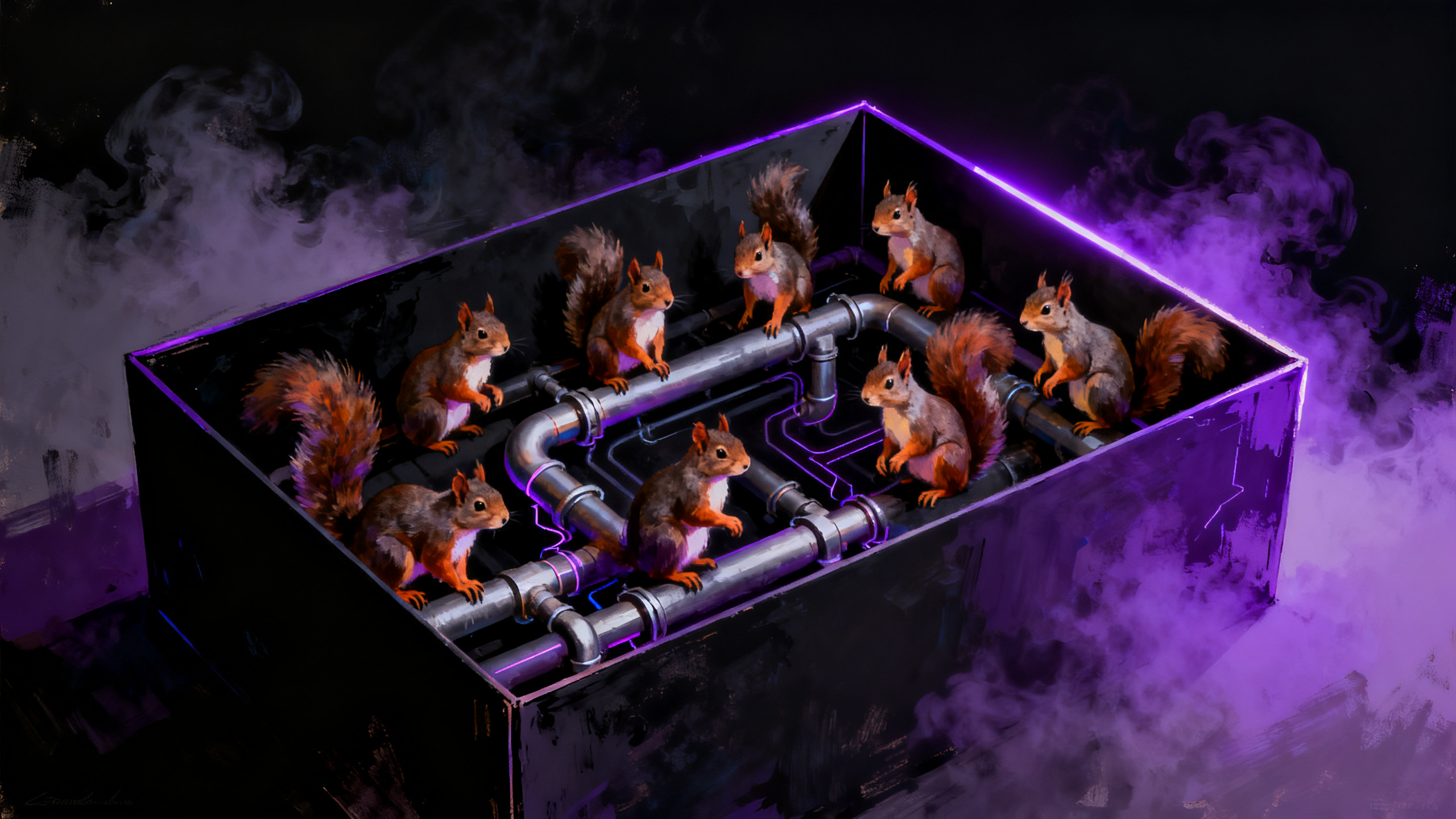
Our creator-in-residence, Alexander Vail, put the craft side of the same answer in the most memorable line of the night, and I'm not sure I can improve on it by paraphrasing: you can make a whole bunch of really cool clips and string them together, unrelated, and have an AI reel. But in order to tell a real story, to have continuity — that is hard. That's going to separate the wheat from the chaff right there. And I liken it to going out to the park and trying to get ten wild squirrels to come into a box. That's what it's like. It's not easy. It is hard. He'd quoted Alvin Toffler right before that — the futurist who wrote that twenty-first-century literacy wouldn't be reading and writing, it would be unlearning and relearning — and the squirrel line is what unlearning and relearning actually feels like on a Tuesday night with a deadline. Getting continuity out of a generative tool isn't a solved problem you execute. It's herding, over and over, until the wild thing finally sits still enough to look intentional.
Then Alex did something better than defend the craft in the abstract — he demonstrated it, live, building a character from nothing while the room watched. His opening frame for the whole exercise: what makes a fictional character stay with us while thousands of others disappear? He walked through a handful of instantly recognizable characters — Yoda, Indiana Jones, Captain Jack Sparrow, Homer Simpson — stripped to silhouette, and pulled out what actually makes them stick, in his words: an identity, something beneath the costume; a flaw, what keeps them getting into trouble; a want; and, the one he leaned on hardest, a contradiction. Homer's contradiction is the whole engine of the character — he takes the path of least resistance again and again, and then, in exactly the moment it counts, wakes up for his family anyway. That surprise, repeated, is why thirty-five years later he's still a character and not a joke that expired.
Then he showed how he actually builds one, and the process he described directly answers David's challenge, move for move. He didn't type "give me a memorable comedian character" into a box and take what came out. He started with a specific, almost absurd what-if — a stand-up comedian who has antlers and never once acknowledges them — played with it, felt whether it had life in it, then iterated: what if he's a monkey instead, still never acknowledging it, still doing his set. That became Eddie Vale, the aging, curmudgeonly comic macaque at the center of his show Night Never Ending — an anthropomorphic fever dream he described as Chinatown meets San Francisco meets Vegas. Every choice in that lineage was specific and his. The tool didn't hand him a finished character. It handed him a fast, cheap way to see whether each specific choice was working before he committed to the next one — composition, then the next composition, exactly the step-by-step control David said he was missing.
Alex's framing for why that iterative loop matters, borrowing from Chuck Jones, the animator behind Bugs Bunny and Daffy Duck: a human actor arrives with a whole life you can pour into a role. A generated character starts as just an image, and the process is a lot longer in order to really develop. It's like a photograph in the old days — you put it in the chemicals and let it evolve. That's not a lesser process than traditional casting. It's a different one, with its own patience required, and pretending otherwise — expecting a finished, fully-realized character on the first prompt — is exactly the "bad writer" failure mode David was warning the room about.
Brian, closing out that thread, drew the line I think matters most for anyone trying to figure out where they personally fit in all this: we believe it's way easier to teach a creative person how to use AI tools than it is to teach an AI person how to be creative. David's challenge wasn't an argument against AI filmmaking. It was a working filmmaker correctly identifying that the tools have to earn the right to be called intentional, one deliberate feature at a time — bibles, locked worlds, shot-by-shot control, a process patient enough to let a character actually develop instead of arriving prefabricated. The word "cinematic" doesn't mean anything on its own. Ten wild squirrels in a box, one at a time, until it holds still — that's what it means to earn it.
That closes out session one of Vibe Filming with LeyLine. If you were in the room, thank you — this series exists because you asked the questions that made it worth writing down. We'll be back with the next one soon.
Comments
Sign in with your Leyline account to join the conversation.