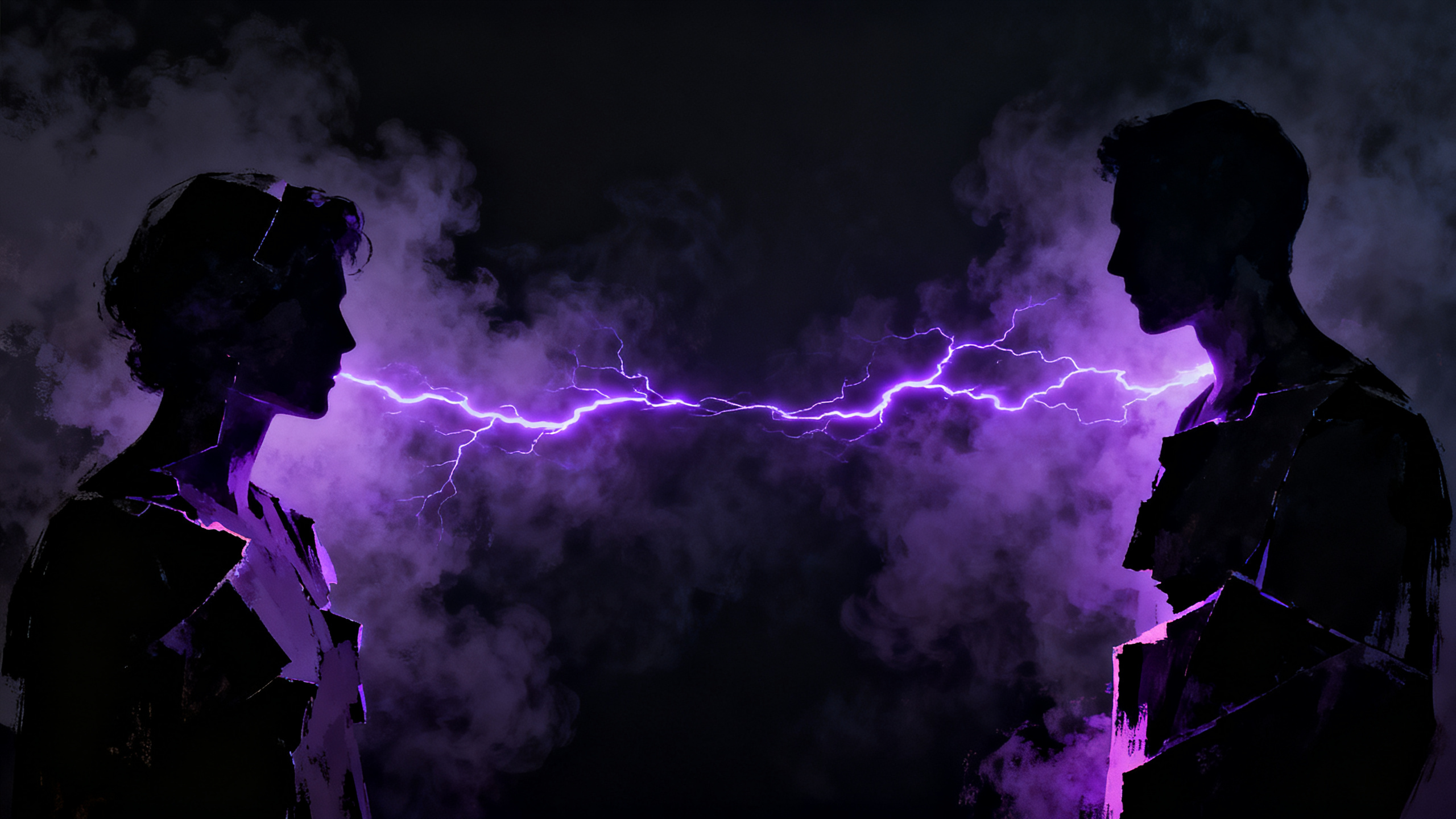
What every last piece of this was actually for. The Vibe Coding Guide — the finale.
I'll tell you the thing the whole series has been walking toward, and it's smaller and more human than all the management theory made it look. I didn't do any of this because I love systems. I did it to get closer to people, and somewhere along the way the getting-closer had been buried under so much machinery that I'd half forgotten it was ever the point.
Here is what I mean. Every piece of content ever made is one person trying to put something that lives in their head into someone else's — a feeling, a story, a way of seeing. That's all it is. That's all it has ever been. And for the entire history of doing it, an enormous distance sat between those two people, and crossing it cost a fortune. To get a story out of my head and into yours I needed a studio, a crew of hundreds, trucks and lights and permits and millions of dollars, and a decade of climbing before anyone would let me near the equipment. To get a product into your hands I needed engineers and offices and runway and someone's blessing. None of that was the connection. It was the distance — the vast, expensive, gatekept stretch of machinery and money and permission that stood between one person's intent and another person's eyes. We got so used to the distance that we mistook it for the work. We called the few who could afford to cross it "creators," and everyone on the far side "an audience."
The whole promise of this moment, underneath the hype and the doom alike, is that the distance is collapsing toward nothing. The crossing that took a crew of hundreds, one person can make now. The crossing that took a fifty-person engineering org, a dummy and one engineer can make. The work didn't get less skilled — the taste, the judgment, the knowing-what-you-want is still the whole scarce thing. It's the distance between that knowing and the other person that's vanishing. And when the distance is gone, what's left standing on both ends is just people: the one with something to say, and the one it was meant for.
Which is why I have to say the dangerous part plainly, because the industry is busy getting it exactly backwards. The point is to close the distance, not to remove the people. And nearly everyone is reaching for the opposite — building machines to take the person out and keep the machinery, pumping out content with nobody behind it, stories no one meant, the slop you can already feel the internet silting up with. That is not closeness. It's the apparatus grinding on with the humans pulled off both ends — all of the output, none of the reason any of it should exist. A machine making "content" with no one behind it isn't reaching anyone. It's a very fast loom weaving nothing that anyone meant, for no one in particular. The value was never the crossing. It was the two people. Close the distance so a person can finally reach another person — take the person out instead, and you've thrown away the only thing that was ever there.
This is my whole strange path finally making sense to me. I trained to tell stories, and I ran from it, because the distance was too far and too cruel and I didn't have the stomach to spend a decade earning the right to cross it. So I sold out. I learned systems, learned the machine, learned to manage instead of make — became, with some real skill, a person who builds machinery for a living. And then the distance started falling away on its own, and I found I'd spent my whole detour accidentally learning the one thing this moment rewards: how to point a machine at what you mean and let it carry you the rest of the way across. Everything in this series — the control, the immune system, the knowledge engine, the company that runs itself one box at a time — was me building a machine to close my own distance, so I could get back to the thing the distance had chased me away from.
And it was never only mine. The reason any of this matters past my own small redemption is that the distance fell for everyone at once. The kid with a story and no studio. The founder with a product and no engineers. The person who could always see the whole thing and never had the means to put it in front of anyone — the stretch they'd been stranded on their entire lives just quietly closed. The same collapse that lets a dummy run a million lines of code lets one person make a film that used to take a thousand, on a browser, with nothing but taste and a machine that listens. The tools change; the closing is the same.
After all of it, I'm most sure of one thing: content was never really about content. It was always about human connection — one person, across whatever distance, reaching another and being, for a second, less alone. That doesn't change when the machinery does. Maybe one day the distance closes the whole way and the apparatus disappears entirely — maybe a story I make shows up as a quick film inside your cybernetic contact lens the moment I look into your eye, no screen, no studio, nothing in between at all. Even then — especially then — it's the same ancient thing it always was: me, looking at you, trying to make you feel something I felt. That is why I'm still here. It's why I was here in the first place, before any of it, and why I spent thousands of hours alone with the machine, crawling through it and back out the other side — not to get closer to the machine, but to get closer to you.
So that's what every last piece of this was for. Not the control for its own sake, not the systems for the love of systems — those were always only the means. The end was two people with nothing left between them. Close the distance. Keep the human on both ends of it. That was the whole point, the only point — and now I get to go be one of them again.
So do you.
This is where the Vibe Coding Guide ends and the camera turns on. The next guide is about film — the same distance, closing, pointed at the other thing it always kept us from.
If this is you
I'll be honest about why I really write all of this in the open: making things this way is lonely. Most nights it's me and a machine, and the machine is not company. The whole reason I'm telling you any of it is the same reason the work matters at all — to be a little less alone in it, and to make you a little less alone too.
So here's where to come find the rest of us:
- You're building or making alone. You don't have to. We run creative cohorts — small rooms of people doing this at the same time — and the thing that surprises everyone is how much better the work gets the moment you stop doing it by yourself. [Join the next one.]
- You've got your own scars from this. Leave them where others can find them. [The comments] are open on purpose — every wall you hit, every thing that worked, every place you think I'm wrong. This whole series only gets smarter if it's more than one stubborn person's mistakes, and a knowledge base we build together outlasts any of us.
- You just want the tools. The field manual — the actual playbook, the templates, the checklists — is on its way. [Get on the list.]
I'd rather build a room you want to be in than sell you anything. Come be less alone.
Comments
Sign in with your Leyline account to join the conversation.