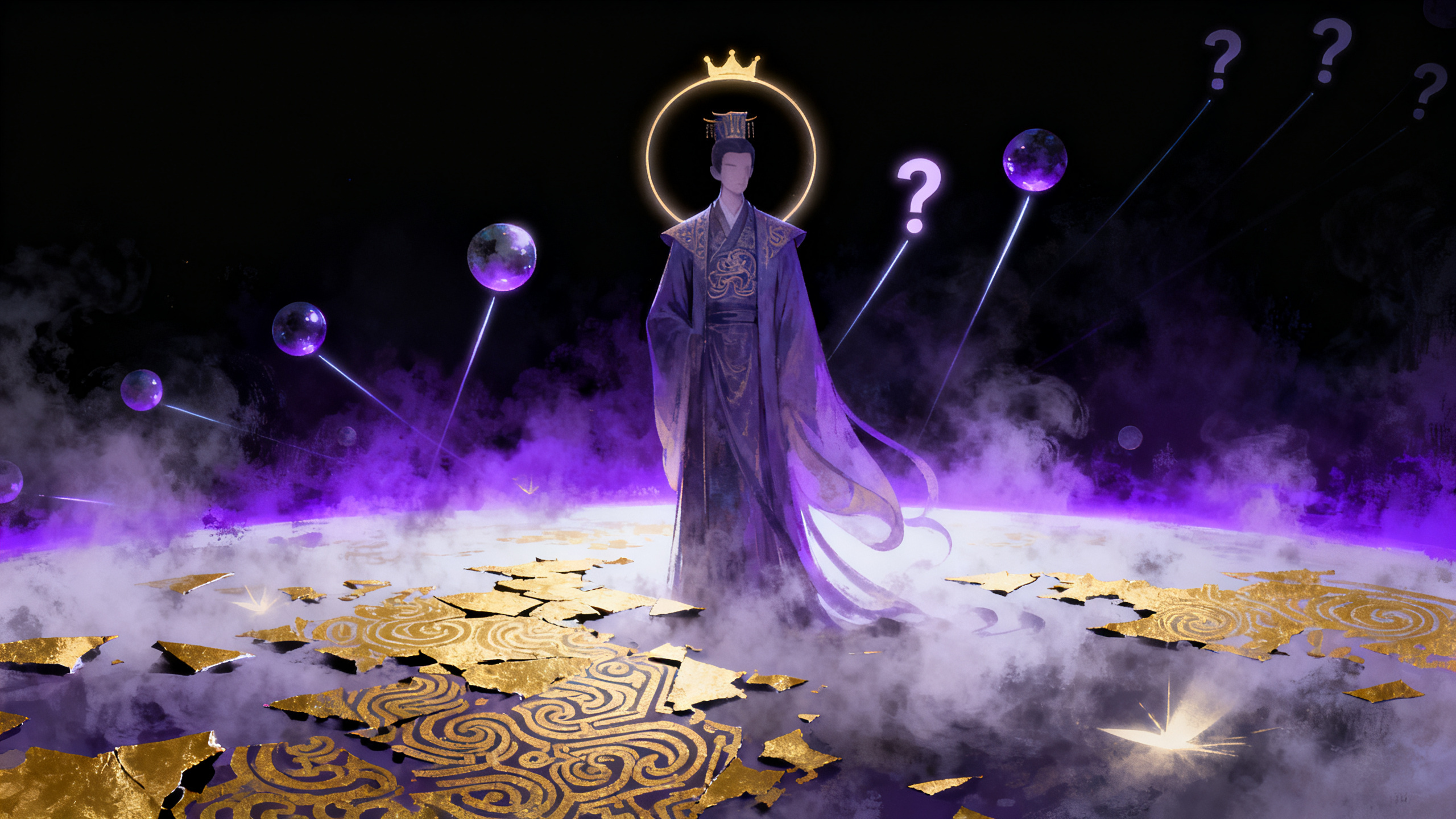
How a rogue who couldn't do anything won an empire — and accidentally wrote the only prompt that matters. Part of the series.
Everyone selling AI advice will tell you the secret is to prompt better: be precise, be detailed, tell the machine exactly what you want, as if the whole game were a matter of knowing the right words to say. For a long time I believed that, and felt permanently disqualified by it, because I cannot read the code the machine writes and never will. How was I supposed to tell it exactly what to do when I don't know exactly what should be done? It turns out I had the whole thing backwards. The single most useful thing I do with an AI — the move that actually built a company — has nothing to do with telling it what to do. I ask. And I learned how from a two-thousand-year-old story about a man who won an empire by being bad at everything.
His name was Liu Bang, and by every account that survives he was a rogue — a minor official with a fondness for wine and a gift for not taking himself too seriously. This is not a legend polished smooth; the historian Sima Qian wrote it down a century later and did not flatter him. Liu Bang couldn't fight. He couldn't run a government. He had no head for supply lines and no genius for strategy — none of the things the founder of a dynasty is supposed to have. His rival, Xiang Yu, had all of them: a born general, physically overwhelming, brilliant on a battlefield, the kind of man the word hero was minted for. On paper it was not a contest. Xiang Yu was better at literally everything that looked like it mattered.
Liu Bang won anyway. He founded the Han dynasty, which ran for four centuries and gave the largest ethnic group on earth its name. And when it was over, seated on top of an empire he had no obvious business running, he explained why — in what might be the most clear-eyed thing any leader has ever said out loud about himself. In planning a campaign from inside the tent, he said, I am worse than Zhang Liang. In running a state and keeping an army fed, I am worse than Xiao He. In leading a hundred thousand men into battle, I am worse than Han Xin. These three are the real heroes of the age — and I could use all three. That is the only reason I hold the empire. Xiang Yu had one brilliant advisor, and couldn't even bring himself to listen to him.
His entire method fit in a phrase he reached for constantly, four characters that come down to a single question: 如之奈何 — what should be done here? He didn't stride in with the answer. He couldn't; he didn't have it. He strode in with the problem, described it plainly, turned to the person who actually knew, and asked. Then he listened. Then he decided. Describe, ask, listen, decide — that was the whole job of the most powerful man under heaven.
I think about that almost daily now, because it is, precisely, how you get the most out of something that is smarter than you about the thing in front of you. The instinct everyone reaches for first — the instinct I reached for — is to command the machine: do this, build that, write it this way. But commanding only works when you know more than the worker. With this worker, on this subject, I never do. So I do Liu Bang's thing instead. I describe what I'm trying to make. I ask the question — what should we do here? — and let it come back with a plan. Then I argue with the plan, because arguing I can do: I know the business, the users, the money, the thing we're actually trying to be, even when I can't read a line of how it gets built. And then I let it go execute, and I watch what breaks. Commands are for workers who know less than you. Questions are for workers who know more. This one knows more.
The lesson I was slowest to admit is the one hiding inside the parable. Liu Bang's superpower was not a skill. It was an emptiness — he had no ego to bruise, because he had never been the smartest man in any room and had made his peace with that long before the war began. Xiang Yu, who was magnificent, could not stand to be outshone, so he held his one genius at arm's length and lost everything. The emptiness was the advantage. The talent was the trap.
I have Liu Bang's emptiness, and it came free with not being technical. I carry no ego about code, because I have nothing there to protect — I was never a coder, so conceding that the machine knows more than I do costs me exactly nothing. And costs nothing turns out to be worth a fortune, because the instant you stop pretending to know, the thing you're working with gets better. Tell an AI honestly that you don't understand something, ask it to explain, ask what it would recommend — and it opens all the way up, lays out the trade-offs, does its best work. Pretend you understand, hand it a confident and slightly wrong instruction, and it will faithfully build your misunderstanding into something that compiles and quietly fails. People are no different; I'd just never had so little reason to bluff. The strongest engineers I know sometimes struggle exactly here — not because they're worse, but because they have more to defend, a hard-won expertise that makes I don't know feel like a little death. The dummy pays no such tax.
The business-school word for what Liu Bang did is delegation, but that word is too small and too tired for it. What he actually understood is that a leader's output was never what the leader could do with their own hands. It is what they can get done through people more capable than themselves — and the only skill that demands is knowing which question to put to whom, and having the humility to take the answer home. He couldn't swing a sword. He could aim the three best swords in history. Aiming them is its own kind of greatness, a different one from swinging, and it is the kind that actually wins the war.
So when people ask how a non-technical founder runs a system she can't read, the honest answer is older than the code by two millennia. I don't run it by knowing. I run it by asking — naming what hurts, putting the right question to something that knows far more than I do, and keeping the one thing that was always mine to keep: the decision at the end. 如之奈何. What should be done here? It was the foundational prompt for a thousand years before there was anything to prompt. It just took a machine that finally answers back for the rest of us to discover the rogue was right all along.
Next: the two-speed mind — where to move fast, and where to move like a bank.
Comments
Sign in with your Leyline account to join the conversation.