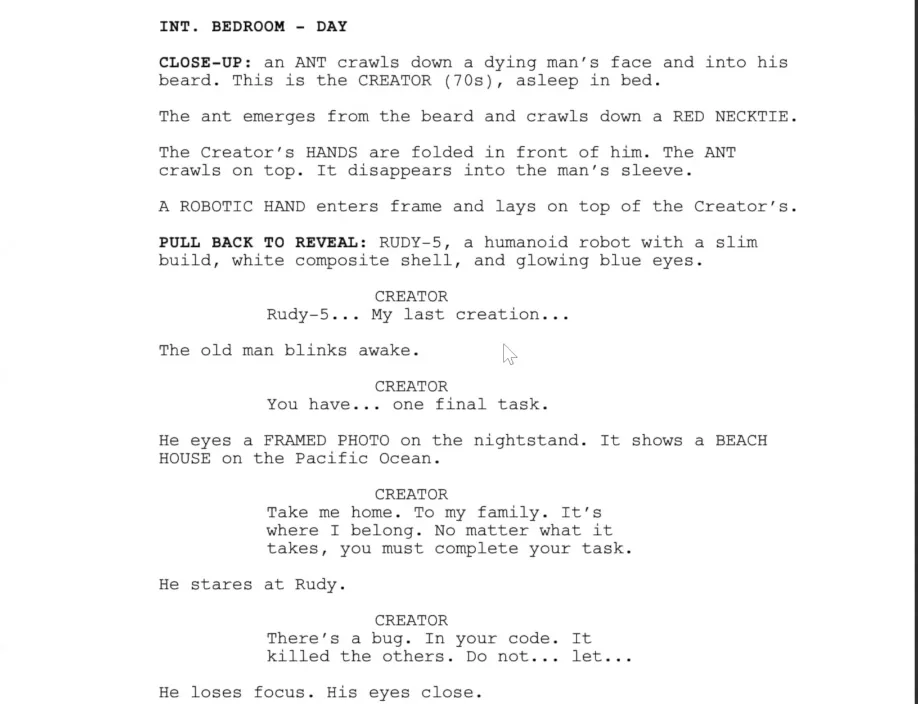
AI video production requires a distinct approach to scriptwriting. This approach often contradicts traditional Hollywood formatting rules. Austin Zartman is an AI filmmaker. He created the AI short-film series ASHES on Leyline. Zartman advocates that the decision to use a camera directions ai video script depends on two factors. First, it depends on the creator's technical vocabulary. Second, it depends on the specific AI platform. Standard screenplays strip away technical camera movements. This leaves room for a director. However, AI filmmakers frequently operate as solo creators. They also work in small teams. This necessitates a different standard for the written page. Writing a camera directions ai video script changes how you plan your shots.
Why traditional rules ban a camera directions ai video script
Traditional screenwriting rules prohibit camera directions to prevent writers from encroaching on the roles of the director and cinematographer.
In standard studio production, the writer provides the narrative foundation. The director dictates the visual execution and camera placement. Writers enter traditional incubators or screenwriting programs. Here, instructors explicitly teach them to avoid technical formatting.
A participant in the AI filmmaking space noted a common trend. Writers are repeatedly instructed never to write specific transitions into a standard script. They must avoid writing camera movements.
Austin Zartman confirms this industry standard. He explains the primary reason for keeping direction off the page. It respects the established hierarchy of a film set. A standard screenwriter is not the person operating the camera. They are not calling the shots on the day of production. Therefore, inserting technical demands into the text oversteps professional boundaries.
However, this strict division of labor rarely applies to the current landscape of AI video generation. In the AI space, creators consolidate the traditional roles. One person acts as the writer, director, and cinematographer. The traditional hierarchy does not exist in a solo AI workflow. Adhering to the old rules of formatting often hinders the production process. It does not help it.
- Traditional writers provide the narrative.
- Directors dictate visual execution.
- Screenwriting programs ban technical formatting.
- Solo AI creators consolidate all these roles.
Should solo creators write a camera directions ai video script?
Solo AI filmmakers should include camera directions in their scripts if it helps them and their small teams visualize the final product.
AI creators typically act as both the writer and the director. Breaking the traditional formatting rule provides a direct benefit to the production workflow. Austin Zartman explains the reality of making an AI series yourself. If you collaborate with a small team, you wear many hats.
In this scenario, the script serves a different function than a traditional Hollywood spec script. It operates as a functional blueprint for your own production process. Zartman states that writing specific camera movements helps you be as specific as possible. You should definitely include that direction directly on the page. A camera directions ai video script becomes a practical asset.
Zach is a production professional. He supports this approach. He points to traditional writer-directors who bypass standard formatting. Zach cites James Cameron’s script for the 1991 film Terminator 2. Cameron wrote the screenplay specifically for himself to direct. Because of this, the script is filled with explicit camera directions. It includes visual cues that meant something to him personally.
The inclusion of camera directions ultimately depends on the intended audience of the script. The document might be meant for a close collaborator. It might be for a friend. It might be for your own reference during the AI generation process. In these cases, technical visual directions become a practical asset. They are not a formatting error.
Do platforms require a camera directions ai video script?
Some AI video platforms require explicit camera directions in the script to generate accurate prompts and usable footage.
Without specific shot types and movements written into the text, certain text-to-video engines fail. They fail to produce the desired visual results. This results in wasted generation time. The mechanics of AI video generation often force the writer to assume the role of Director of Photography (DP). They must do this from the very beginning of the process.
One creator shared an experience using a specific AI platform. This platform translates written scripts directly into video outputs. Initially, the creator inputted a standard, traditional vertical script. This script was completely devoid of camera directions. The result was a failure. The creator described the output as a "mess." The AI system lacked the specific visual instructions needed to frame the scenes correctly.
To fix the issue, the creator realized they had to act as the DP and director within the text itself. The script had to contain explicit camera information. This ensured the AI received the correct prompt. In these specific automated workflows, writing technical directions into a vertical script saves significant time.
It prevents the AI from making arbitrary choices. It stops incorrect choices regarding composition. It stops incorrect choices regarding camera movement. If the platform relies on the script to generate the image prompt, the script must contain the visual data. A detailed camera directions ai video script solves this problem.
- Generates accurate prompts.
- Produces usable footage.
- Saves significant generation time.
- Prevents arbitrary AI composition choices.
What if you lack technical vocabulary for a camera directions ai video script?
Creators who lack the technical lexicon for specific shots and camera movements should exclude camera directions from their scripts.
AI filmmaker Austin Zartman advises writers to prioritize telling the best story possible. Writers must visualize the series in their mind's eye. They should do this over forcing unfamiliar industry jargon. While camera directions aid the prompting process, they are not strictly mandatory. They are not mandatory if they disrupt the writer's natural workflow.
Zartman emphasizes that creators should do whatever is most comfortable for them during the drafting phase. Writing terms like "pan," "tilt," or "dolly" might not come naturally. Attempting to force them into the script will only hinder the creative process. It will slow down the writing phase. A forced camera directions ai video script creates unnecessary friction.
Instead of getting bogged down in technical vocabulary, Zartman suggests focusing entirely on the narrative. The most important element of the scriptwriting phase is visualization. The creator must start to see the series clearly in their mind's eye. A strong, compelling story is the foundation of any successful AI video project.
If a writer lacks the specific terminology to describe a shot, they have alternatives. They can write descriptive, visual prose. This prose conveys the emotion and action of the scene. It does this without relying on strict cinematographic labels.
When to figure out staging without a camera directions ai video script
Staging, composition, and vertical framing should be finalized during the image generation phase rather than the initial scriptwriting phase.
Austin Zartman separates these processes. This separation allows creators to focus entirely on the narrative on the page. They do this before addressing the specific visual mechanics of the frame. For creators who choose to omit camera directions from their scripts, the technical visual work shifts. It simply shifts to a later stage in the production pipeline.
Zartman views the image generation phase as a distinct part of the filmmaking process. It is a subsequent step. Once the story is locked on the page, the creator transitions. They move into the role of the director and cinematographer.
It is during this image generation phase that the creator must actively think about constraints. They must consider the constraints of the vertical frame. This is the exact point where decisions take precedence. These decisions involve staging. They involve character placement. They involve specific compositional rules.
By separating the writing phase from the image generation phase, AI filmmakers gain an advantage. They ensure the story remains the primary focus early on. They still maintain strict control over the final visual output. They exercise this control when they begin prompting the AI models to generate the actual footage.
- Staging and blocking.
- Character placement.
- Vertical framing constraints.
- Specific compositional rules.
Frequently asked questions
Can I use terms like "push" and "cut" in a camera directions ai video script?
Yes. Traditional screenwriting avoids terms like "push," "cut," and "transition." This avoids stepping on a director's toes. However, AI filmmakers can use these terms freely. Austin Zartman notes that AI creators wear many hats. Including these directions directly aids the solo production process.
Did James Cameron use camera directions in his scripts?
Yes. According to production professional Zach, James Cameron included extensive camera directions in his script for Terminator 2. He wrote the screenplay for himself to direct. This proves that writer-directors benefit from including specific visual cues. They benefit from writing camera movements directly on the page.
What happens if I omit directions in an AI script-to-video platform?
Omitting camera directions in certain AI script-to-video platforms can result in disorganized footage. It can result in unusable footage. One creator noted a specific failure. Feeding a standard, directionless vertical script into an AI platform created a "mess." The AI lacked the necessary prompts to frame the shots correctly.
Should I write a camera directions ai video script if I do not understand the terminology?
No. Austin Zartman advises against it. Writing camera directions might not feel natural. You might lack the technical lexicon. If so, you should leave them out. The primary goal of the script is to establish the story. It helps you visualize the series in your mind's eye.
Comments
Sign in with your Leyline account to join the conversation.