The Iterative Process AI Filmmaking: A Practical Guide
The iterative process AI filmmaking relies on is a core workflow built on cycles of generation, review, and refinement. Unlike traditional filmmaking where assets are created once, this method involves generating an output, assessing its quality, and then adjusting inputs to regenerate it. This loop is repeated until the result aligns with the filmmaker's vision. This method creates a collaborative partnership where the filmmaker guides the AI tool through successive versions. A hands-on approach is essential, as AI models are non-deterministic and benefit from precise, repeated human guidance. The entire foundation of modern AI filmmaking rests on this hands-on, cyclical approach, making a mastery of the iterative process AI filmmaking a fundamental skill.
What is the Core Loop of the Iterative Process AI Filmmaking?

The core loop of the iterative process in AI filmmaking is to generate, review, and regenerate an asset until it meets your creative standard. This cycle applies to every stage of the production, from writing to final image rendering. This core loop consists of three distinct actions:
- Generate: Create an asset using a text prompt, image prompt, or other inputs. This could be a character concept, a keyframe, or a script segment.
- Review: Critically assess the output. Does it match the visual style? Is the character on-model? Does the lighting fit the scene's mood? The filmmaker must carefully check the details.
- Regenerate: Adjust the inputs to correct any issues found during the review. This might involve rewriting the prompt, changing a parameter like a seed number, or providing a new reference image. And then the cycle repeats.
AI filmmaker Austin Zartman, creator of the AI short-film series ASHES, describes this as an essential part of the workflow that demands patience. He notes that for a single image, the process is far from a one-click solution.
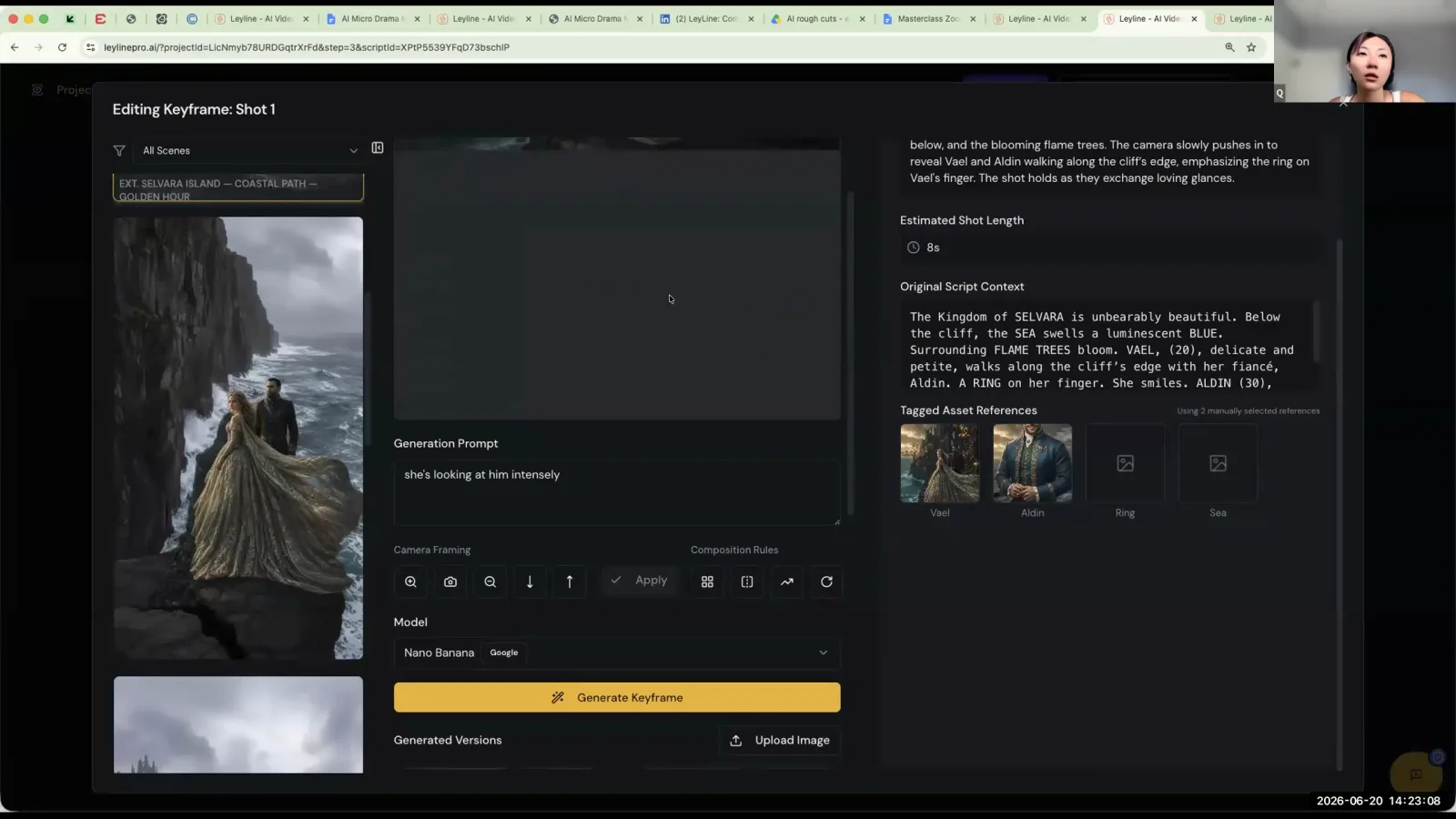
"It's an iterative process," Zartman explains. "Look, you only have three versions of the image right here. Like, generally people take like more than 10 to get to that image that they really like." This highlights the reality of the work involved in the iterative process AI filmmaking. Achieving a specific character pose, lighting setup, or environmental detail requires numerous attempts. The filmmaker must continually refine their text prompts, adjust parameters, or even change the seed image to steer the AI closer to the intended outcome. Zartman emphasizes that this is where filmmakers should invest most of their energy, particularly in the pre-video stages. "You just need to keep doing this. It's takes a lot of patience... Just keep rendering, re-rendering until it comes out... until you got everything right in the keyframe step."
How Much Manual Work Does the Iterative Process AI Filmmaking Involve?
AI filmmaking typically follows an 80/20 rule, where the AI generates about 80% of the desired output, and the filmmaker must manually fix, guide, or refine the remaining 20%. This principle underscores that AI is a powerful assistant, not a fully autonomous creator. The human element is critical for bridging the gap between what the AI produces and what the story requires. The iterative process AI filmmaking is the mechanism for applying this crucial 20% of human oversight.
Zartman clarifies this dynamic: "AI is not 100% accurate... it's like 80/20 rule. Now it's like 80% there. You just got to fix that 20%." This 20% of human intervention is what ensures quality, consistency, and narrative coherence. This manual work often includes tasks such as:
- Editing images in software like Photoshop to correct artifacts.
- Compositing multiple AI-generated elements into a single cohesive frame.
- Rewriting or refining AI-generated script dialogue to fit a character's voice.
- Correcting continuity errors in character appearance or props across shots.
Without it, the final product can diverge significantly from the original vision. The value of this hands-on approach is immense. As Zartman states, "If you fix it every step, you get like 90% close to what you need. If you just let AI do your thing, in the end, you get like probably something that's like 20% like what you wanted. That's why the human needs to be there to check."
Why Is the Iterative Process AI Filmmaking Crucial for Consistency?
The iterative process in AI filmmaking is necessary because AI models are not deterministic and can "hallucinate" or introduce inconsistencies, especially when building upon their own previous outputs. Each time you ask the AI to perform a task like generating a script breakdown or a series bible, it can produce a different result. This variability requires the filmmaker to constantly review and correct the AI's work to maintain a consistent world and narrative. This is a central challenge that the iterative process AI filmmaking is designed to solve.
A clear example of this occurred during Zartman's masterclass. When a series bible was generated a second time, the AI began to hallucinate details. "When you did it the first time, all it did was extracting the information from your script and made it into a Bible," an attendee noted. "The second time you hit it, the program used the information that was generated the first time to recreate. So there's more liberty that it has taken." This shows how AI can drift from the source material if not carefully managed through an iterative loop with human oversight.
This applies to visual elements as well. AI image models are not inherently smart about context or continuity. "The image generation models are not that smart," Zartman says. "So basically, whatever input it gives it, it infers." He gives an example where if a character sheet is too complex, the AI might get confused and render a prop, like a spatula, inconsistently across different images. The key is iterative prompting, a central tenet of the iterative process AI filmmaking: "give it the kind of information, um, as little as possible, but as much as needed is the best way to be working with these kind of stuff." The filmmaker must repeatedly test prompts to find the right balance for consistent results.
How Does Iteration Fit Into the Iterative Process AI Filmmaking Pipeline?
In a structured AI production pipeline, iteration is managed through a sequence of steps where manual approval is required at each stage to lock in decisions and maintain consistency. Changes made at an early step will cascade forward, requiring re-iteration of all subsequent steps. This structured approach prevents chaotic, unpredictable changes from undermining the project. The iterative process AI filmmaking is not a single, monolithic loop but a series of smaller loops contained within each production stage.
Zartman outlines a logical production order where each step is its own iterative cycle:
- Series Bible: Establish the core world, characters, and rules. Iterate until this foundation is solid and approved.
- Script: Write the narrative. Iterate on scenes, dialogue, and pacing before locking the script.
- Designs: Create character sheets, environments, and prop designs. Iterate until the visual style is locked.
- Breakdowns: Generate shot lists and asset requirements from the script. Iterate to ensure accuracy.
- Keyframes: Generate the most important frames for each shot. This is a highly iterative step to define the final look.
- Render: Generate the final video sequence from the keyframes. And then move to post-production.
This linear progression ensures that foundational elements are set before moving to more detailed work. He explains the dependency: "If you change anything from like step A, then A + 1, A + 2 should change." This cascading effect means that a script change might force a regeneration of breakdowns and keyframes. Because of this, "a manual approval and manual confirmation is always needed" to move from one step to the next.
This process prevents a common pitfall: making a late-stage change that conflicts with early-stage decisions. For instance, changing a character design after keyframes are generated would create a major inconsistency. The iterative process AI filmmaking, when contained within each step and approved before proceeding, brings order to the otherwise unpredictable nature of generative AI.
Frequently asked questions
What is the 80/20 rule in AI filmmaking?
The 80/20 rule, as described by AI filmmaker Austin Zartman, suggests that AI tools can typically accomplish about 80% of a creative task. The filmmaker is then responsible for the final 20% of refinement, correction, and creative adjustment to achieve a professional, polished result.
How many versions does the iterative process AI filmmaking require for a good image?
It is an iterative process that often requires many attempts. According to Austin Zartman, it is common for filmmakers to generate more than 10 versions of a single image to achieve the specific look, composition, and feel they want for their project.
Can AI "hallucinate" during the iterative process AI filmmaking?
Yes, AI can "hallucinate" or take unintended creative liberties, especially when regenerating an asset based on a previous AI output. This happens because the AI builds upon its own generated information, which can introduce drift and inconsistencies from the original source material.
Where should I focus my efforts in the iterative process AI filmmaking?
Austin Zartman advises spending the majority of your time iterating on the keyframe step. He recommends getting the keyframes exactly right through repeated rendering and refinement before moving on to the final video generation phase, as this stage offers significant control over the final look of a shot.
Keep learning
This guide is part of the Technical Troubleshooting for AI Filmmaking masterclass lesson.
Related guides:
Comments
Sign in with your Leyline account to join the conversation.